Entrepot360.ca
FREN
Try the demoDemo

Warehouse software · food manufacturers

Still running your warehouse in Excel?

A spreadsheet doesn’t scan anything, doesn’t know where the pallet is, and will never tell you which customer a lot went to. Entrepot360.ca does: every product, its lot, its date and its place, from the purchase order to the delivery slip. Your Excel cells paste in as they are — it’s the last time you’ll open them to look for a pallet.

We set it up at your site. Your racks measured, your labels ready to put up, your catalogue imported, your team trained: you start with a warehouse that’s ready, not with empty software.

In real time with QuickBooks. Every invoice, its customer, its items and its taxes are written to your QuickBooks Online on their own. Nothing to re-enter.

Born on the dock of a food bank, adapted for businesses that buy and sell

  • Nothing to install
  • No device to buy
  • Application in English and in French · Français
  • Hosted in Canada
  • Connected to QuickBooks
  • CRM included
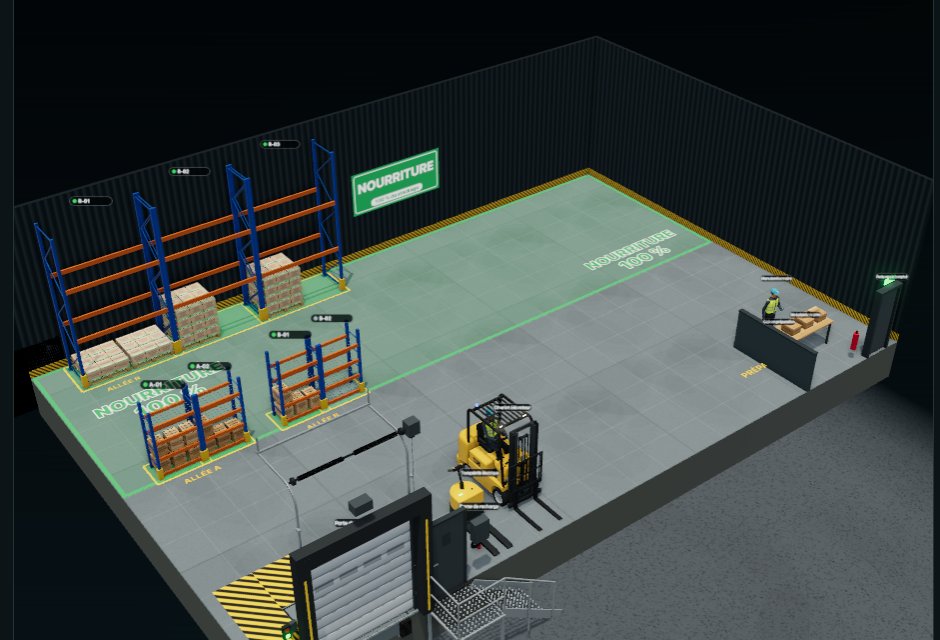
A bakery’s warehouse in three dimensions, to scale: the pallet rack, the shelving, the forklift and the dock
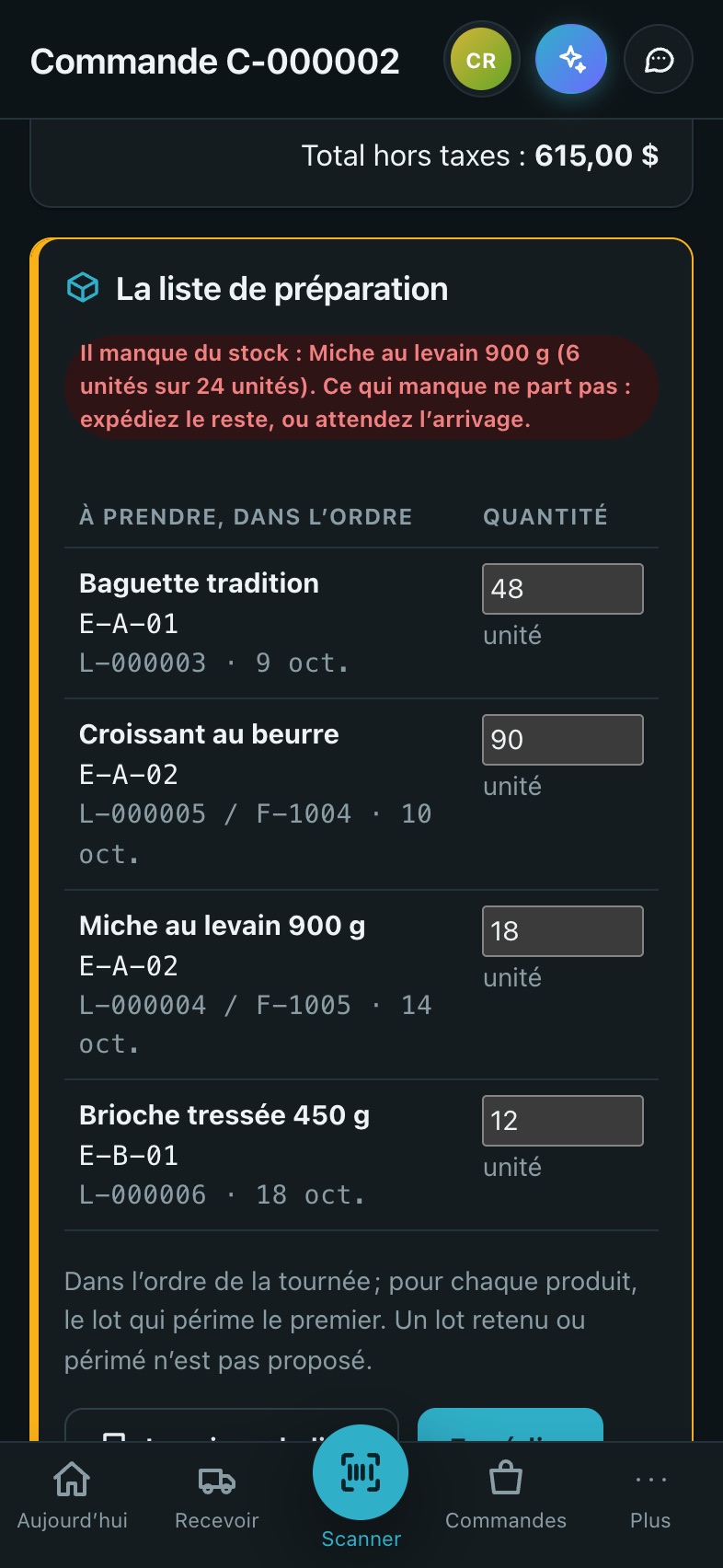
On an iPhone, the pick list for an order: the lots to take, the one that expires first on top
Set up for youWe measure your racks, prepare your labels, import your catalogue and train the team. Nothing to install: a web address, and you scan.
QuickBooks, in real timeThe invoice issued at the warehouse is in QuickBooks Online a second later; paid or cancelled here, it is there too.
A CRM includedCRM: customer relationship management. Who to contact, what was said, what you offered, who to follow up with today. And an accepted quote becomes an order with one button.
The phone is the scannerThe camera of an iPhone — or an Android phone — reads the barcodes. No scanner to buy.
From order to delivery slipThe customer’s order becomes a pick list, then a delivery slip with its lots.
A copy every dayAutomatic backup. One click is all it takes to go back.
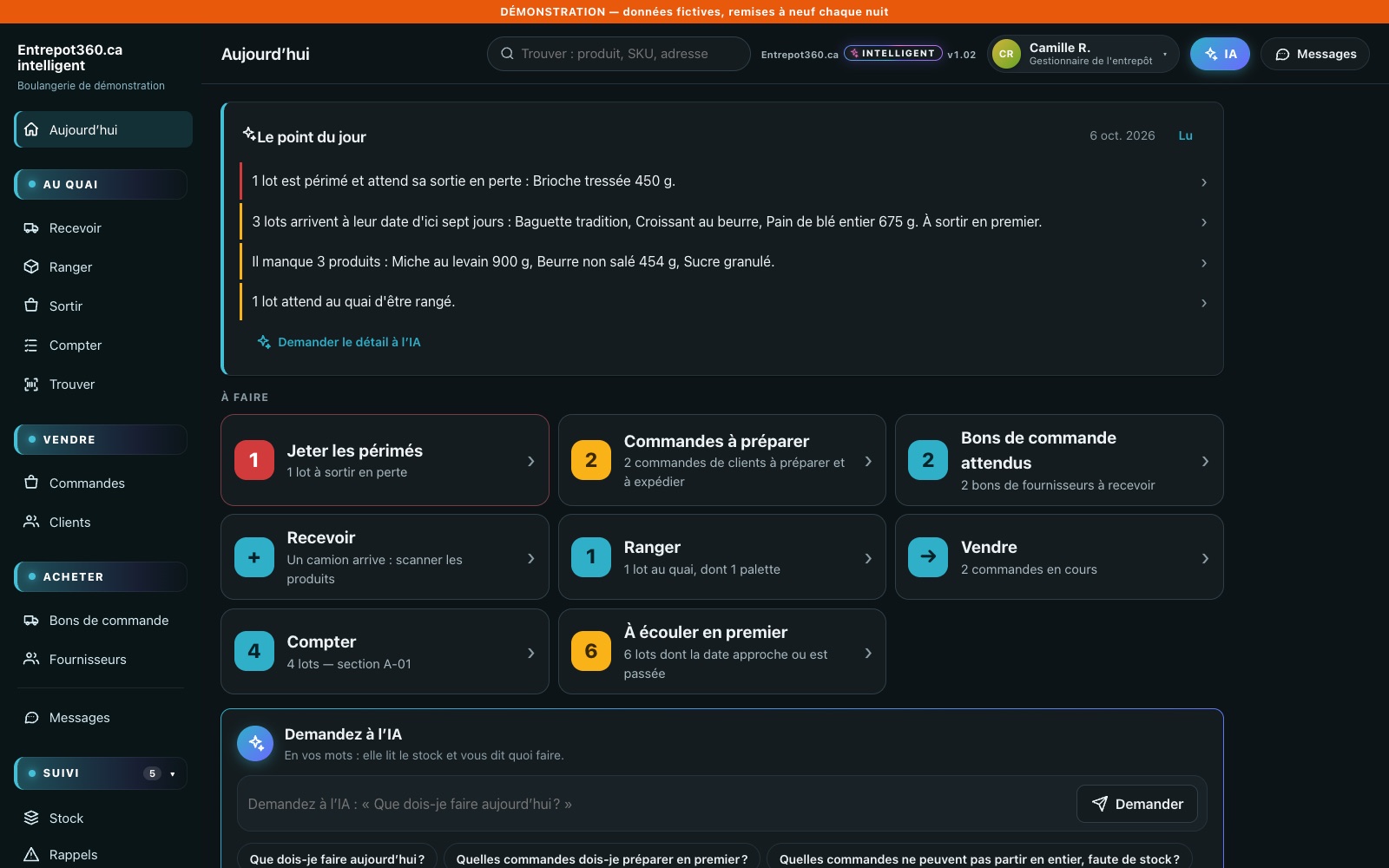
A bakery’s morning screen: today’s briefing, then the tasks — two orders to pick, two purchase orders expected, receive, put away

Every morning, the screen says what needs doing, in order: what is missing, what is waiting at the dock, what to pick.

Your warehouse’s digital twin

Watch it move.

Digital twin n. — A faithful copy of your warehouse on screen, in three dimensions: same measurements, same racks, same pallets. It follows the real stock with every scan: what you see there is what is on the floor.

The truck backs up to the dock, the driver unloads the pallet, the forklift picks it up and lifts it into the rack — along the real aisles, to the real measurements of your building.

  • The delivery and the forklift in action, started with one button in the digital twin.
  • An aisle too narrow for the forklift? You see it before moving a single rack.
  • For training, presenting to the board, or planning a new layout.

Does this sound like your warehouse?

Today

  • You find an expired product when you empty the shelf.
  • “Is there any left?” — someone goes to the back to check.
  • The office spreadsheet doesn’t say the same thing as the pallets.
  • A recall notice comes in: nobody knows where the lot went.
  • The new employee doesn’t know where to put things away.
  • You look for a pallet: it was moved, and nobody wrote it down.
  • The annual inventory closes the warehouse for two days.
  • The week’s sales are retyped into the accounting software.
  • A customer calls about their order: someone has to go check at the dock.
  • Everything rests on one person’s memory.
  • You order what you already had, and run out of what you thought you had.

With Entrepot360.ca

  • The morning briefing flags what is about to expire, seven days ahead.
  • Type the product’s name: its section, its quantity and its date appear.
  • Stock updates with every scan; the office sees right away what the dock has just done.
  • Traceability shows which supplier the lot came from and which customer it went to.
  • The application suggests the place; you confirm with one tap.
  • Every pallet has its address; a move is scanned.
  • You recount one section a week, without closing anything.
  • Sales and purchases for the period come out as a file, ready for your accounting software.
  • Every order has its pick list, then its delivery slip.
  • Everything is recorded: anyone can find, put away and pick.
  • A threshold per product flags what to order, before you run out.

A day with Entrepot360.ca

Four actions on the phone. The rest takes care of itself.

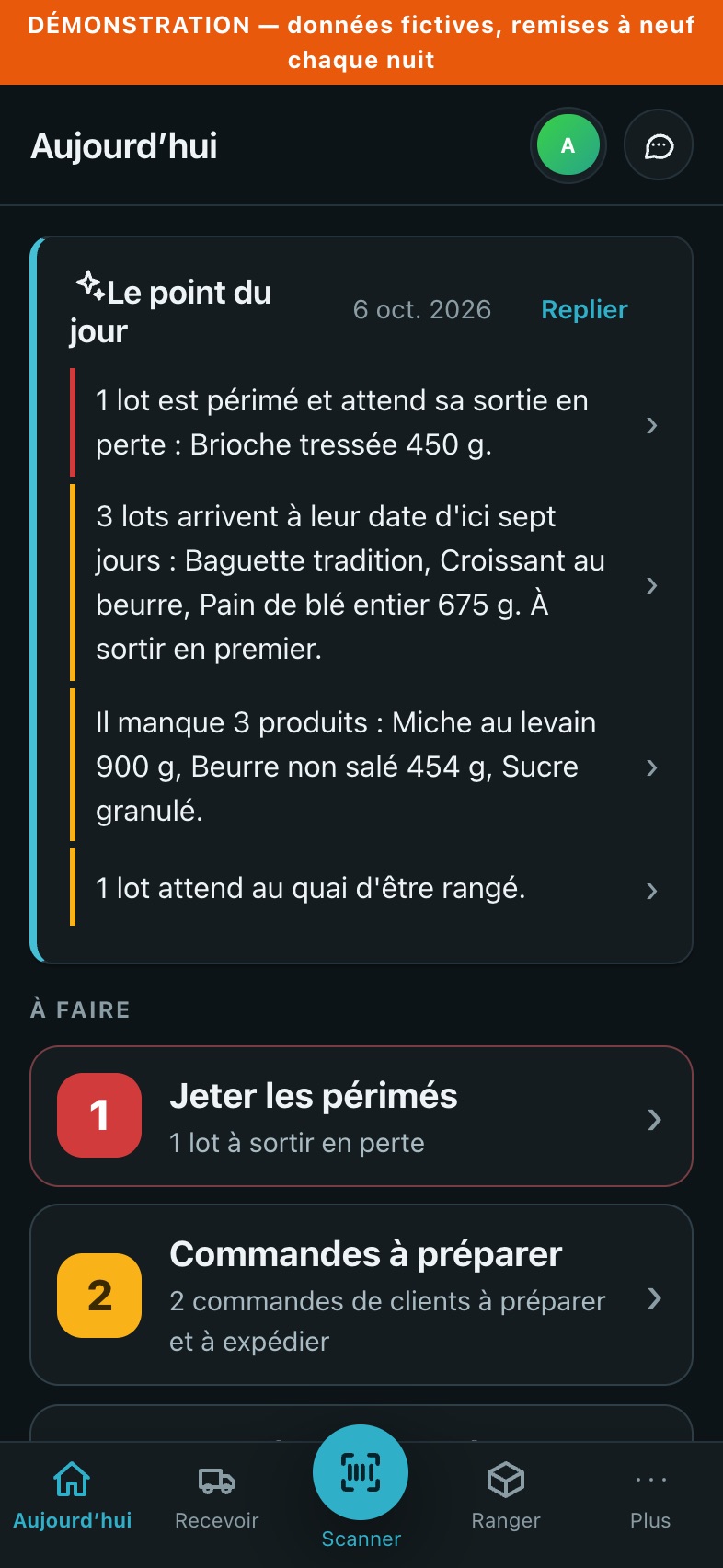
  1. The morning screen on the phone, in a bakery: today’s briefing, then the orders to pick and the purchase orders expected

    7:30 a.m. · Today’s briefing

    What to do, and in what order.

    One main action per screen, large buttons, the number of tasks waiting. You know where to start, without having to ask.

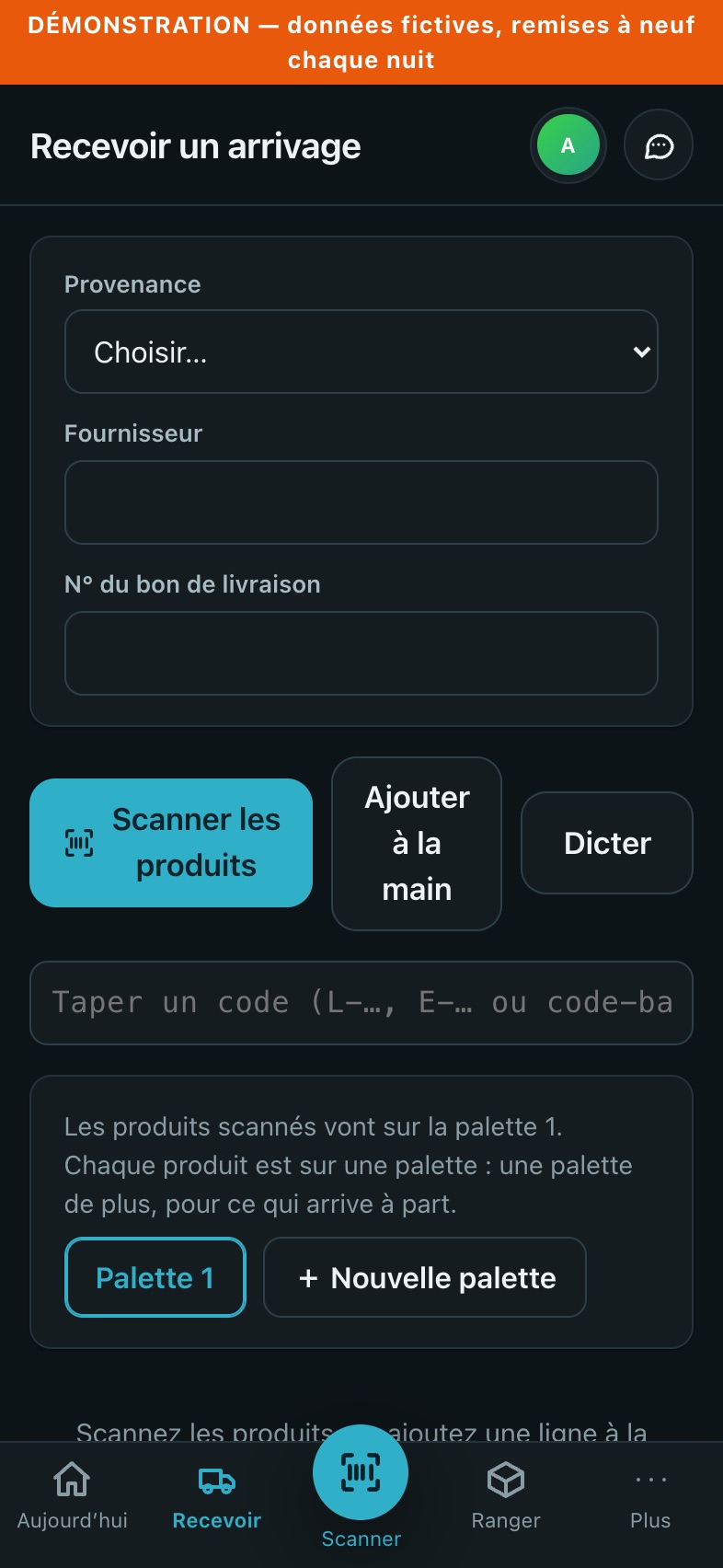
  2. The Receive a delivery screen: the source (purchase, production, customer return), the supplier, and the Scan the products button

    9:00 a.m. · The truck arrives

    You scan, pallet by pallet.

    The source, then each product. A barcode that won’t read? Add the line by hand, or dictate it.

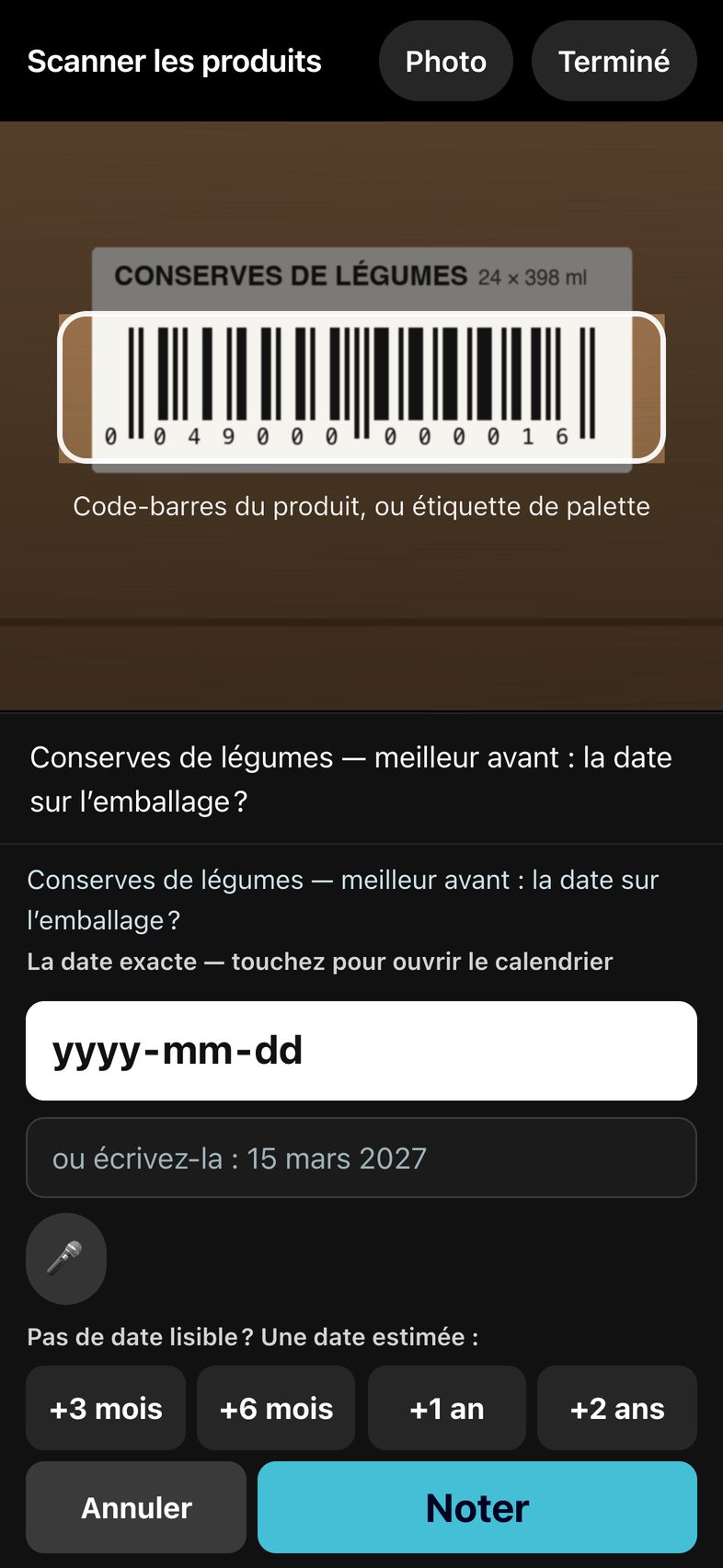
  3. The camera is aimed at the barcode on a can; the application asks for the date on the package, with estimated dates one tap away

    9:05 a.m. · The quantity, the date

    Two questions, and it’s recorded.

    How many, then the date on the package. No readable date? An estimate in one tap: +3 months, +6 months, +1 year.

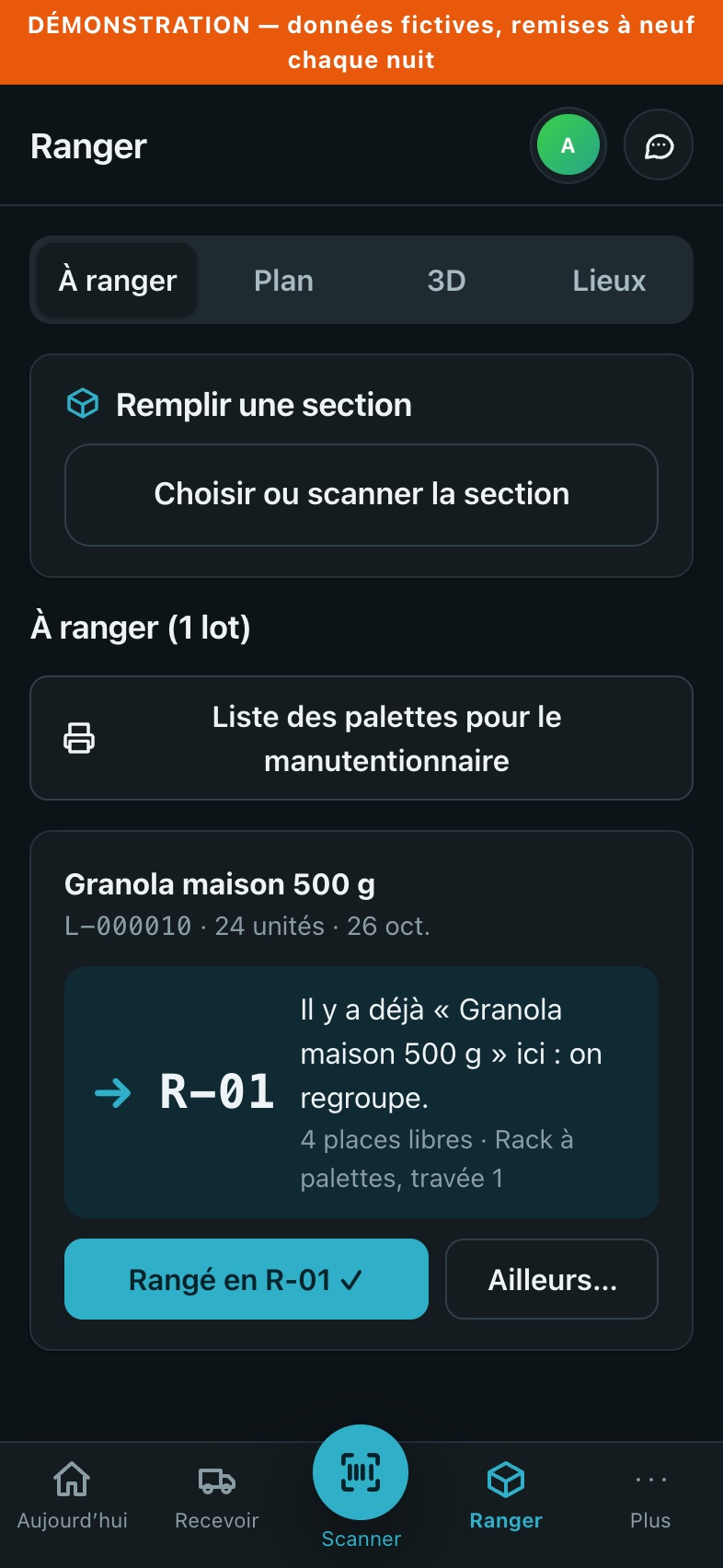
  4. The Put away screen on the phone: the lot waiting at the dock and the suggested section

    9:20 a.m. · Putting away

    The application suggests the place.

    Where the same product already is, or in the section for its category. Put it somewhere else? Scan that section.

Everything it does, in detail

Dates and rotation

Nothing expires on the shelf.

Every lot carries its date. The software knows what has expired, what will reach its date within seven days and what has no date.

  • When stock goes out, the lot that expires first leaves first, even if it arrived after the others.
  • “Best before” products stay good for some time after their date: the tolerance grid is set by category.
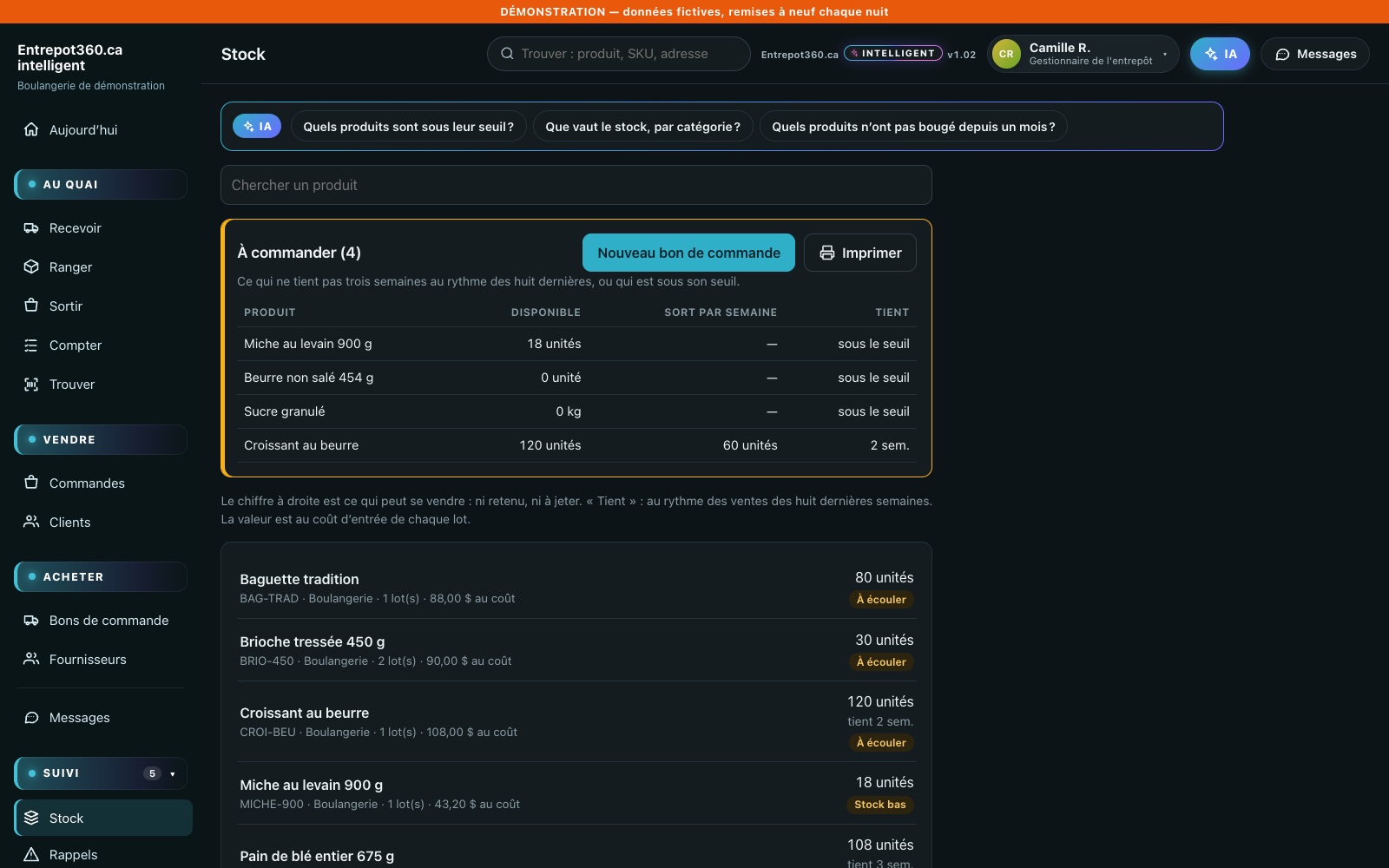
  • A threshold per product: the “to request” list builds itself as soon as stock falls below that threshold.
A bakery’s Stock screen: what needs ordering, then each product with its SKU, its quantity, its value and its status

Plan and addresses

Every pallet has its address.

Row, bay, level, position. You enter the measurements of your building and your racks: your warehouse appears on screen, to scale. That is its digital twin, to view as a floor plan or in three dimensions.

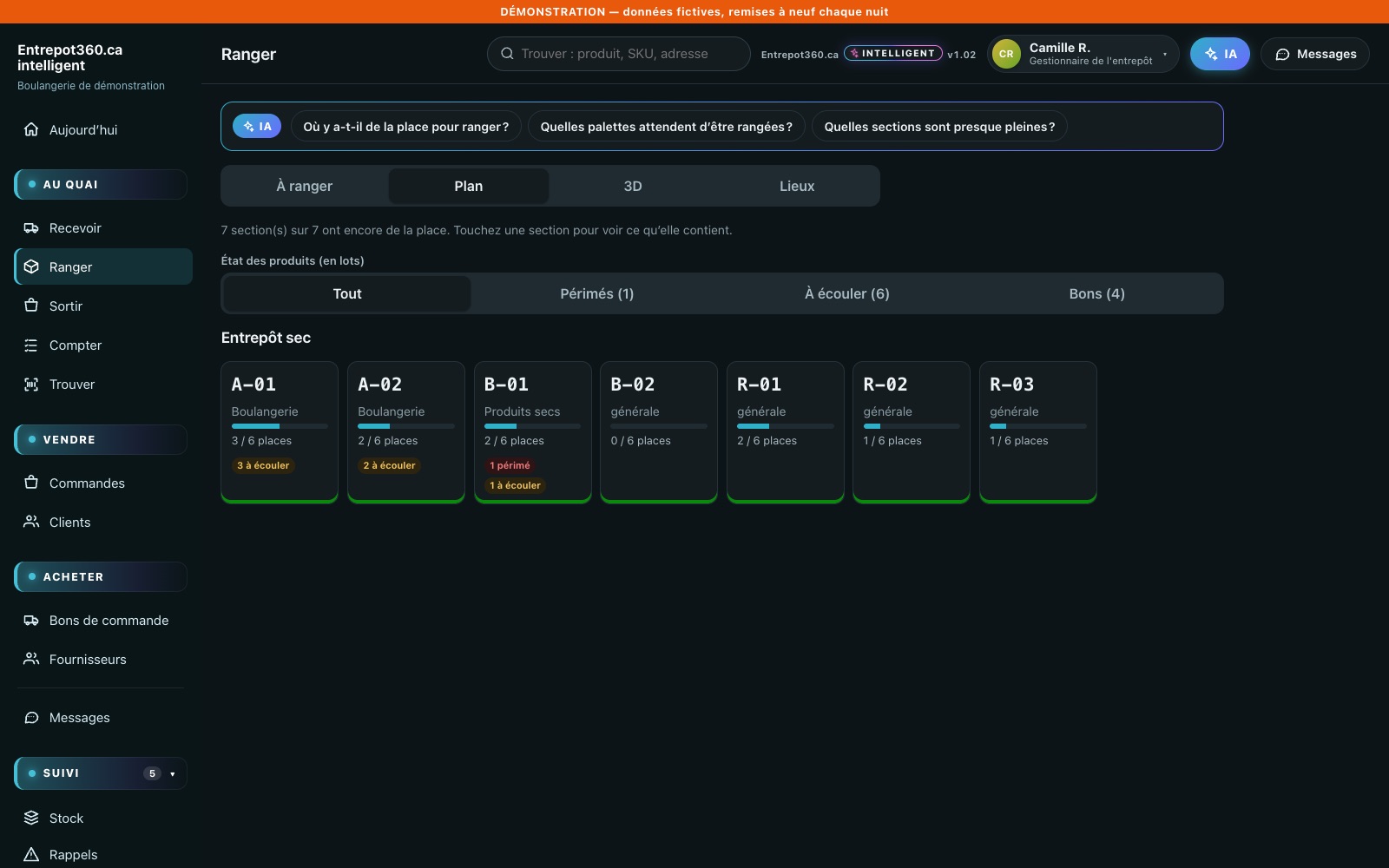
  • How full each section is, and its lots that are expired, to use soon or without a date.
  • A filter by status dims the rest: you see at a glance where to act.
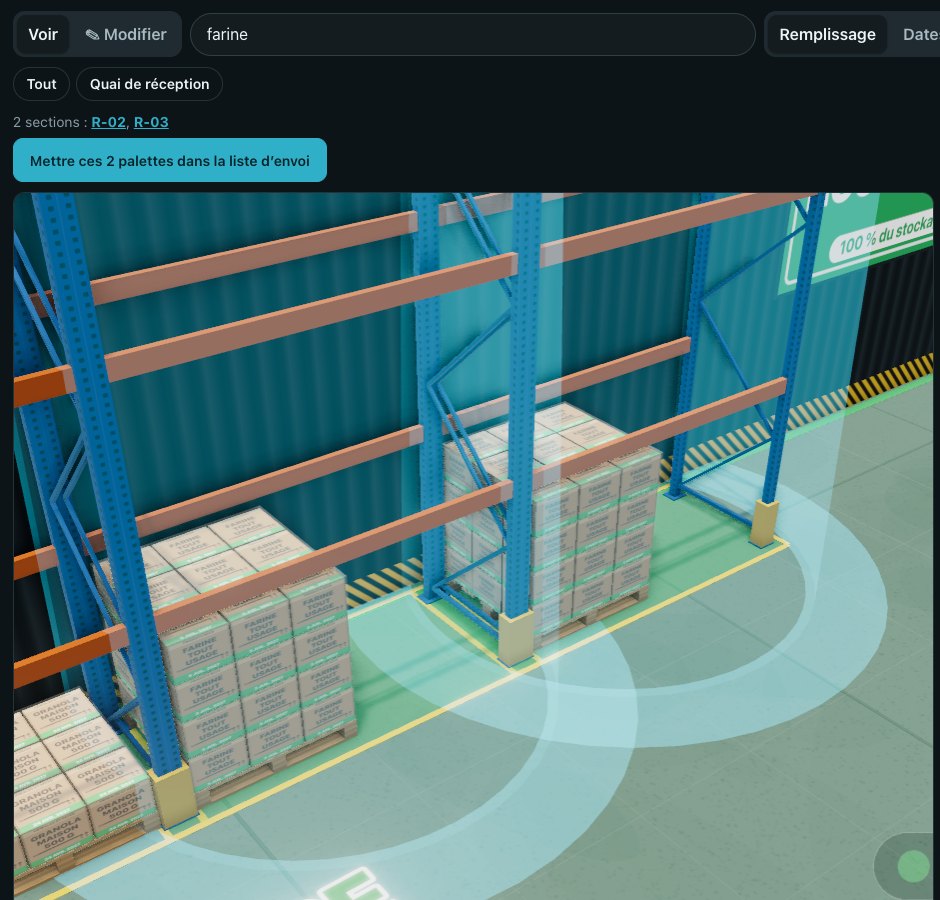
  • “Where is the flour?” — the bays light up.
  • Section and pallet labels to print, ready to scan.
In a bakery’s digital twin, someone typed “farine” (flour): two sections, R-02 and R-03, light up under a beam of light
Type “flour”: the two sections that hold some light up.

Product status

The state of the whole warehouse, section by section.

Each section shows its dots: expired in red, to use soon in yellow, no date in grey. You choose what goes out by status or by product — the whole pallet follows.

  • Shipping lists prepared pallet by pallet, checked off at the dock.
  • Stock is deducted only on departure, in a single release.
A bakery’s warehouse plan: its sections, how full they are, and what each one holds

Traceability and recalls

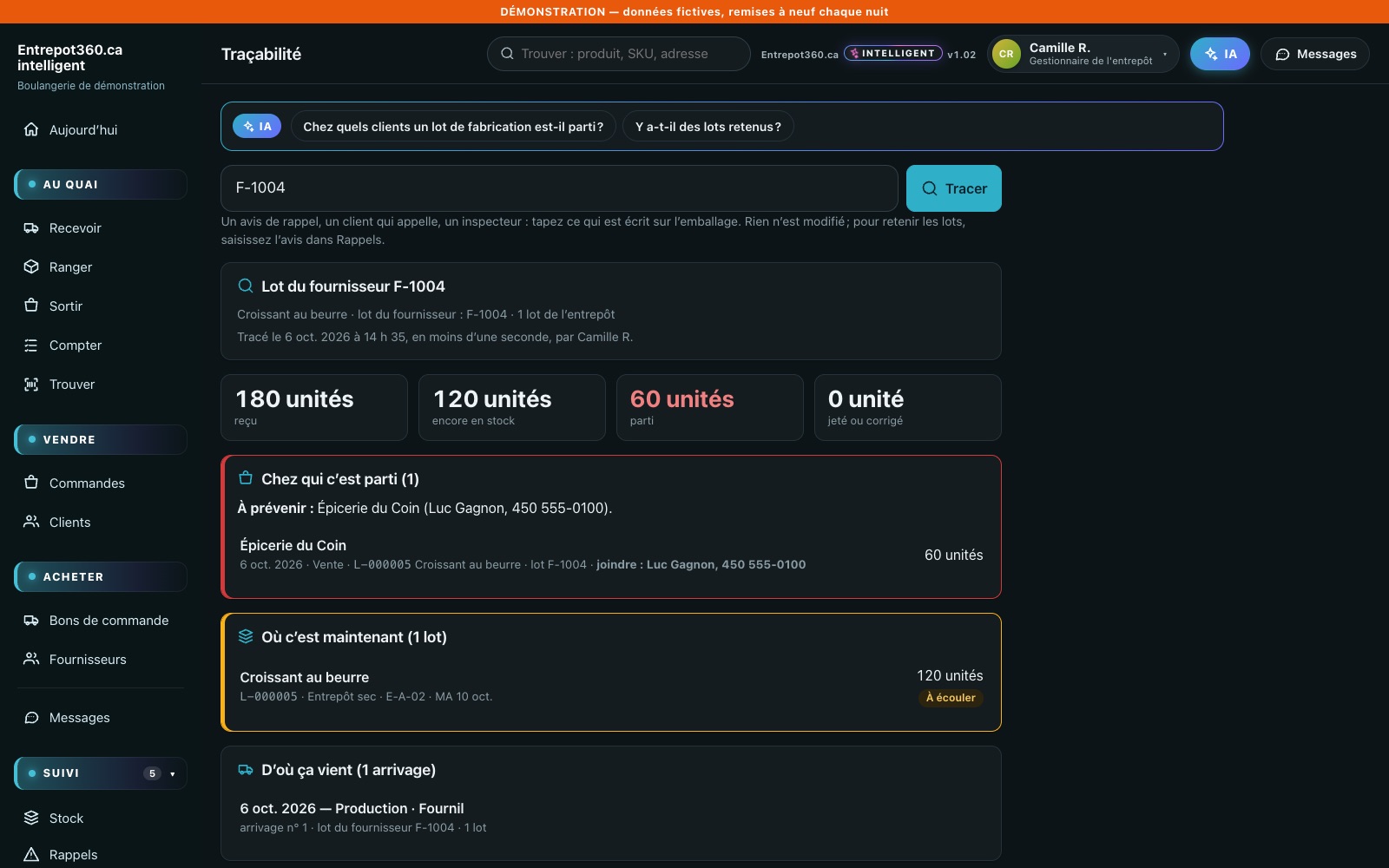
A recall? The answer in one second.

Type what is printed on the package: the software says where the product came from, where it is now, and who it went to.

  • The lots concerned are blocked in one step: they can no longer go out.
  • One step back, one step forward: the supplier and its lot, then each customer delivered, with who to contact.
  • Every movement is signed and dated. The log is never rewritten.
A production lot’s traceability: received, still in stock, gone — and the customer who received it, with who to contact

Selling and buying

From the order to the delivery slip.

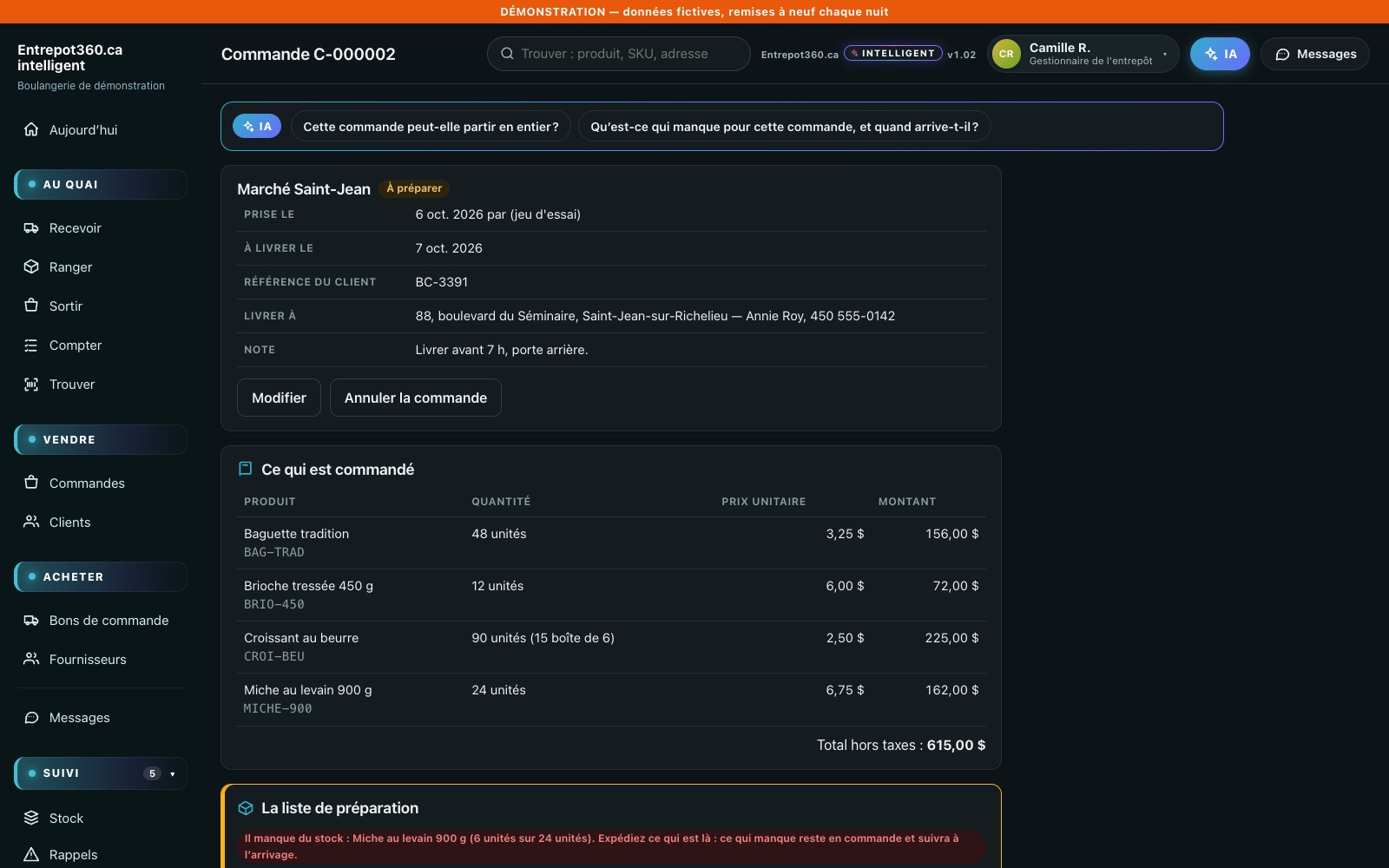
You take a customer’s order; the dock gets its pick list, the lots that expire first on top. At shipping, stock goes down and the delivery slip prints, with its lot numbers.

  • Your products have their SKU, their cost and their price; your stock has its value.
  • If stock is short, what is there ships, and the rest follows as a backorder: the order stays open until it is complete.
  • Purchase orders are received at the dock: each lot keeps the cost paid.
  • Your catalogue and your inventory come over from Excel, checked line by line before going in.
  • Invoices, with GST and QST, are issued at each delivery slip and written to QuickBooks Online; sales and purchases also export as a file for other accounting software. Entrepot360.ca does not replace your accounting.
A customer’s order: what is ordered, with prices and the total, then the pick list lot by lot

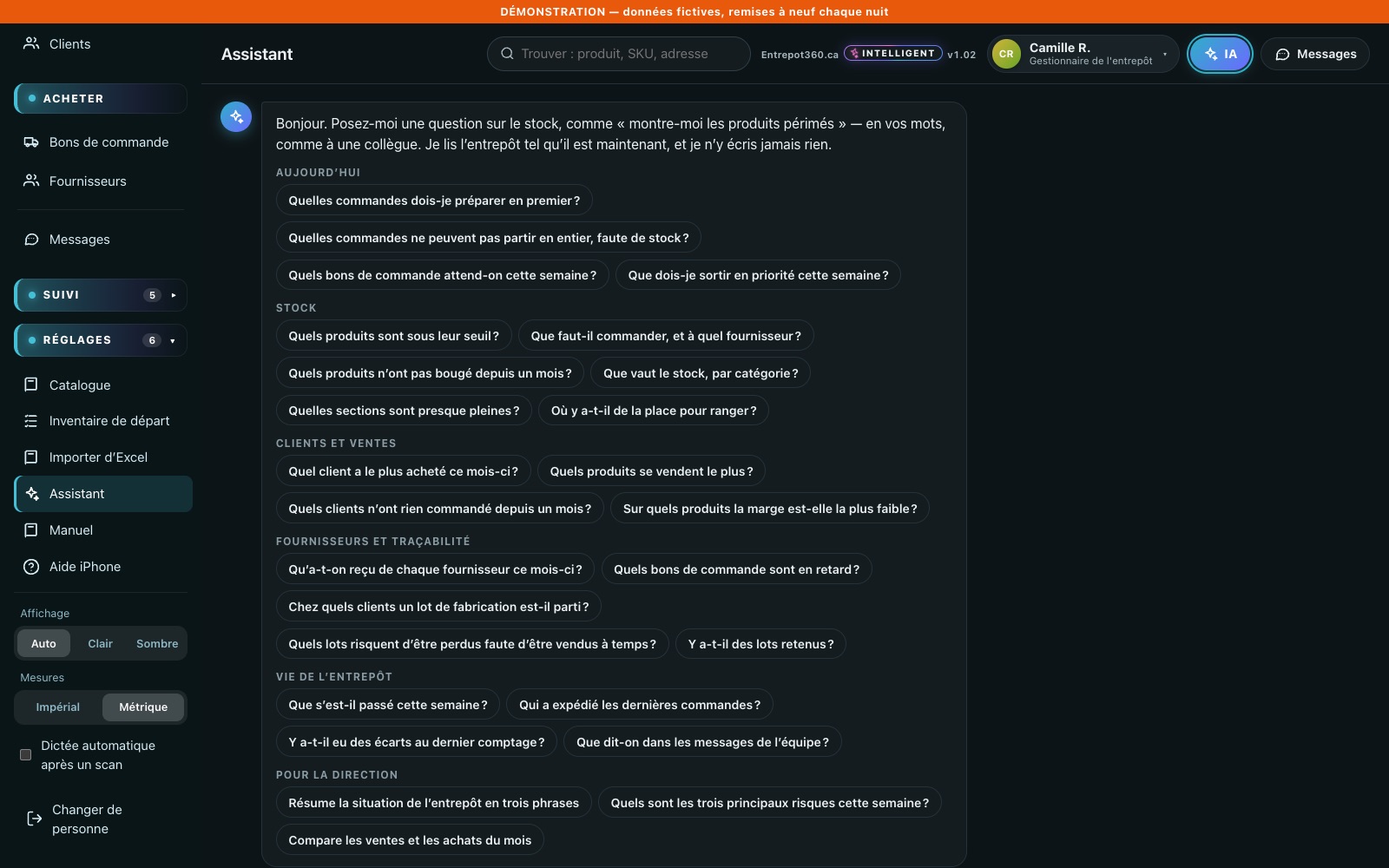
Assistant · optional

Ask your question in plain words.

“Which orders should we pick first?” “How much flour?” “What expires this week?” The assistant looks at the stock and the orders as they are right now.

  • It never writes to the stock: it answers, you decide.
  • A local assistant is included in every plan; the AI assistant, for free-form questions, is included or optional depending on the plan — the pricing section says which.
  • Each person can turn it on or off on their own device.
A business’s assistant: ready-made questions about orders to pick, thresholds, customers and suppliers
And also: eight more features
  • A catalogue that fills itselfA barcode never seen before? Its record is looked up online and added to your catalogue.
  • Dictation“Twelve, March 15”: dictate the quantity and the date, even with your hands full. In English or in French.
  • MessagesThe office writes to the dock, the dock reports a problem. Without leaving the application.
  • Guided tourAt first sign-in, each person is guided through their own screens, with video.
  • Several zonesDry, refrigerated, frozen: each zone has its plan, and cold zones have their readings.
  • LabelsSections, pallets, lots: codes to print on an ordinary printer.
  • BilingualEach person chooses their language, on their own device.
  • Updates includedNew features install themselves and are announced on screen. Nothing to reinstall.

Customer follow-up, without a spreadsheet

CRM included — optional

Each customer’s history, right in the warehouse.

A CRM is the memory of the relationship: who to contact, what was said, what you proposed, what was accepted. Ours is simple, and it lives in the same software as your stock and your orders — not in another one.

  • Contacts: several per customer, with their role, email and phone; imported from Excel in one go.
  • Dated notes and follow-ups: every exchange leaves a note; a follow-up is set for the date you want, and “To do today” brings it up when you open the application.
  • Quotes: in a few lines, at that customer’s prices (negotiated rate or discount), emailed from here. The customer answers in one click — “I accept” or “Let’s talk”; once accepted, it becomes the order.
  • Sales in progress: your quotes by column — open, followed up, expired, accepted, declined — with their amounts. A declined quote always says why: price, lead time, competitor, no need.
  • Automatic follow-ups: a quote with no answer for seven days follows up on its own (the delay can be adjusted).
  • Customers going quiet: the one who ordered every week and has taken nothing for three comes up on its own, before the account is lost.
  • The timeline: a customer’s notes, quotes, orders, deliveries, invoices, payments and emails, in a single list; their sales over twelve months, their last order and their average order at the top of their record.
  • The assistant drafts the follow-up in the tone of your exchanges, or sums up a customer before your call.
  • Renewals: a quote accepted for one year sets its own follow-up eleven months later.

This is not a CRM for campaigns or forecasting: no mass mailings, no lead scoring. It is follow-up a salesperson keeps up in two minutes a day. And if you don’t want it, it switches off in the settings: customers, orders, slips and invoices stay.

See customer follow-up in the demo

Everyone sees what concerns them

Four profiles, four ways into the same warehouse.

At the dock

The warehouse worker

A phone, large buttons, one action at a time. Receive, put away, release, count. Nothing else on the screen.

In the warehouse

The manager

The morning briefing, the stock, the plan, the orders to pick, the purchase orders expected, the recalls. They know where to act before anyone asks.

At the office

Management

Sales, purchases, the value of the stock, the state of the dates. They take the orders, without going down to the warehouse.

In the settings

The administrator

Accounts, the catalogue, thresholds, backups, the log. Everything is set on screen, without a technician.

Who it’s for: SMEs that run a food warehouse

Processors, bakeries, distributors

A pallet rack, lots, dates, customers to deliver to — and nobody to administer a big system. Here, the software talks about products, customers, orders, delivery slips and suppliers. You open an address in a browser, bring your catalogue over from Excel, and the team scans from day one.

Are you a food aid organization?

The same software has a view for food banks: donations, hampers, emergency food aid, reports to funders. See the Food bank view.

Up and running in three steps

  1. We open your warehouseAn address of your own, a database of your own. You receive your administrator access.
  2. You describe the premisesYour zones, your sections, their measurements. The plan draws itself; you adjust it.
  3. The team scansA starting inventory on the phone, and the guided tour trains each person on their own screens.

Your data stays yours

What sets us apart

Three ways to run an SME warehouse, and ours. Other software does many things well; here is what you will only get here, and what you will get here without having to look for it.

Entrepot360.caExcelOnline inventory softwareAn enterprise WMS
Set up at your siteRacks measured, labels, catalogue imported, team trainedEverything is up to youA subscription: you enter everything yourselfA project of several months, through an integrator
Your warehouse in 3D, to scaleThe plan is drawn from your measurementsNoNoRarely
In French, by people from hereWritten in French first, support in QuébecYour spreadsheet, your wordsMostly English, support by ticketDepends on the integrator
Your data in CanadaHosted in Canada, a copy every dayOn your computers, with no safe copyOften in the United StatesVaries
Lots, dates, serial numbersEvery lot and every number, traced on one pageNoDepends on the planYes
The purchase order prepares itselfBelow the minimum, or when an order is short of stockNoYesYes
Invoices with GST and QSTAt each delivery slipBy handDepends on the software and the countryThrough the accounting software
QuickBooks in real timeIncluded: invoices, customers, taxes, paymentsRe-entryYes, often as an add-onBy integration, on quote
CRM: customer follow-upIncluded: quotes, contacts, notes and follow-upsAnother fileRarely: a separate CRM, to connectNo: a separate CRM
Simple manufacturingBill of materials, components consumed, cost of goodsNoDepends on the softwareYes
AI assistant that reads your stockIncluded in the SME plans, in FrenchNoRareRare
Getting startedIn a few days, with usRight away, but on your ownWeeks, on your ownMonths
Accounts included5 accounts included, 15 with SME PlusOne file, one person at a timeVaries: sometimes two accounts on the first tier, sometimes unlimited; often paid one by oneOne licence per user
Price$249 per month, 5 accounts included“Free”, plus your hoursUS$160 to US$440 per monthThousands of dollars, plus implementation

CRM: customer relationship management; ours is simple follow-up, without campaigns or sales forecasting. Comparison by families of solutions, based on what their publishers post as of October 2026; each product has its own particulars. Ask us to compare with the one you are looking at: we will do it line by line.

And compared with Odoo?

Odoo is a full business management suite: it aims to replace all your software, accounting included. We do one thing, your warehouse, and we set it up for you.

Entrepot360.caOdoo
What you are buyingA warehouse ready to work: stock, sales, purchasing, invoicesA full suite, with dozens of applications to choose and configure
Your accountingYou keep QuickBooks: the real-time link is includedOdoo has its own accounting; the link with QuickBooks goes through a third-party connector
SetupDone by us, at your site: racks measured, labels, catalogue imported, team trainedSold separately: Odoo service packs or an integration partner, often over several weeks or several months
HardwareThe phone or tablet you already have: its camera reads the barcodesOften handheld scanners or dedicated inventory terminals, to buy on top
Your warehouse in 3D, to scaleThe plan is drawn from your measurementsNot out of the box
How the price is counted$249 per month, 5 accounts included; $20 per additional accountPer user: $44 per month on the Standard plan billed annually, $35.20 the first year
A team of 5, for one year$224 per month, or $2,689 per year$220 per month, or $2,640 per year ($176 and $2,112 the first year)
A team of 10, for one year$324 per month, or $3,889 per yearYou save $1,391 per year (26%)$440 per month, or $5,280 per year ($352 and $4,224 the first year)
A team of 15, for one year$404 per month, or $4,849 per yearYou save $3,071 per year (39%)$660 per month, or $7,920 per year ($528 and $6,336 the first year)

Taxes extra, on both sides.

Odoo prices in Canadian dollars, billed annually, as posted on odoo.com on October 7, 2026; the teams are priced for twelve months on both sides, ours with the 12-month commitment discount (−10% on the plan), without Odoo’s implementation services or the hardware; the savings are counted against its regular price, the one for the second year and after. Odoo does far more than a warehouse: to replace your accounting and your sales as well, it is a good choice. For a warehouse in order in a few days, while keeping QuickBooks, that’s us.

Frequently asked questions

Do we need to buy barcode scanners?

No. The phone’s camera reads barcodes right in the application: an iPhone or iPad, where everything was fine-tuned, and also an Android phone with Chrome. At the office, a computer and its browser are all you need.

Is there anything to install?

No. Entrepot360.ca opens in the browser, at an address of your own. On an iPhone, you can add it to the home screen: it then opens like an app.

What happens without Internet?

The software is online: it needs Wi-Fi or a cellular connection. After a brief outage, the screen retries on its own when the network comes back.

Can we bring over our catalogue and inventory from Excel?

Yes. You copy the cells from Excel and paste them into the import screen, or drop a CSV file there. The software checks everything and tells you, line by line, what is wrong; nothing goes in while an error remains.

Is it accounting software?

No. Entrepot360.ca keeps track of stock, orders, delivery slips and purchase orders. It issues your invoices with GST and QST at each delivery slip, writes them to QuickBooks Online, or exports your sales and purchases as a file for other accounting software. It does not replace your accounting: no general ledger, no payroll, no tax returns.

Our employees are not used to computers. Does it take long to learn?

The dock profile has only a few large buttons and one action per screen. At first sign-in, a guided tour walks each person through their own screens, in a few minutes.

Not all our products have a barcode or a date.

That is covered: you add the line by hand or dictate it, and an estimated date is entered with one tap. Products without a date are tracked separately.

Can we start with the products we have now?

Yes: a starting inventory is done on the phone, section by section. We can also help you get started.

Is there a commitment?

The plan is monthly. A longer commitment earns a discount; it is not required.

Does the AI assistant see our data?

With the AI option, the question and the stock data needed to answer it are sent to the AI provider for the time it takes to answer; the assistant never writes to your data. Without that option, the local assistant answers without anything leaving the server.

About us

Entrepot360.ca was born in a warehouse, not in an office. The software was designed on the floor of a food bank in Québec, with the people who receive the trucks, put away the pallets and prepare the shipments.

Every screen answers a problem met on site: an expired product found too late, a pallet nobody can find, a new employee who doesn’t know where to put things away. That is why the software is simple at the dock and complete at the office.

Our team is based on Montréal’s South Shore. When you write to us, they are the ones who answer.

  • Designed in QuébecIn the field, with a food bank.
  • Proven every dayBy one of the largest food banks in Québec.
  • Hosted in CanadaYour data stays here.
  • Reachableinfo@entrepot360.ca

What we commit to

See it with your own products

Tell us who you are: we will show you the software and open a trial warehouse in your name. No commitment.

  • A live demonstration, with your questions
  • A trial warehouse in your name
  • An answer from a real person, not a robot

Prefer to write to us directly? info@entrepot360.ca

Our team is based on Montréal’s South Shore.

By sending this request, you agree that we keep your contact details, for twelve months at most, to answer you — nothing else. See our privacy policy (in French).